Case study
ReadTheMOT, a product of my own
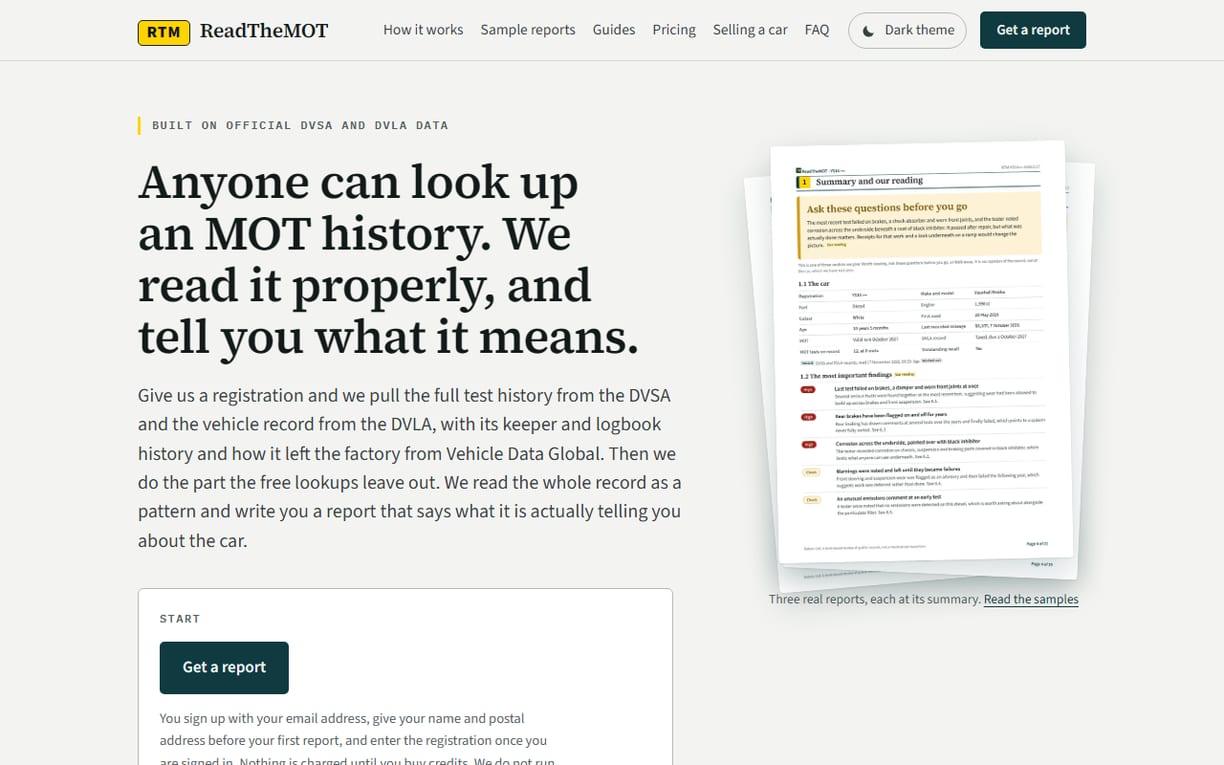
Anyone can look up a used car's MOT history. ReadTheMOT reads it properly and writes the buyer a report on what it means. Nobody commissioned it, so it shows the way I build things when the only client is me.
Being precise about what this is
Everything else on the work page is a client's system. This one is Dalaric's: I designed it, built it and run it, and it sells reports to the public at readthemot.uk. It is here because it is the clearest small example of two of the things I offer, joining up other people's data and putting a language model to work without letting it make things up.
The problem
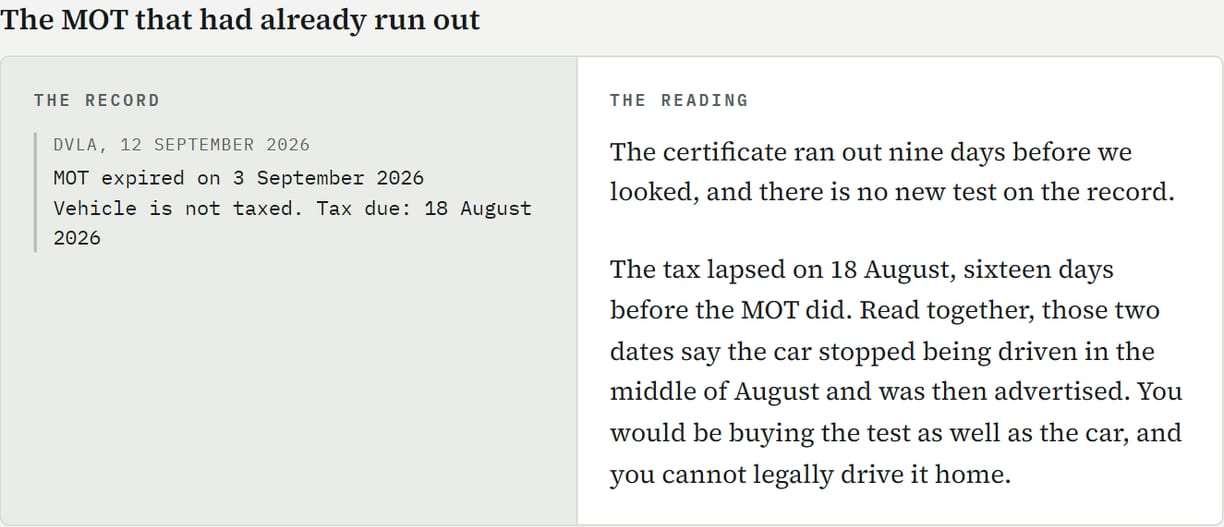
It started as a favour: helping somebody buy a used car in the first week of September 2026. Twelve cars were checked properly, one at a time, across Dorset and Somerset. Eight of the twelve had a material problem the advert did not mention: an MOT that had expired before the car was listed, an airbag warning lamp recorded as dead, a failed test four days before the car was advertised as ready to go.
None of it was hidden. It was all in two free government databases. It just needed reading, and reading a record properly takes about twenty minutes that most buyers do not know how to spend.
What it does
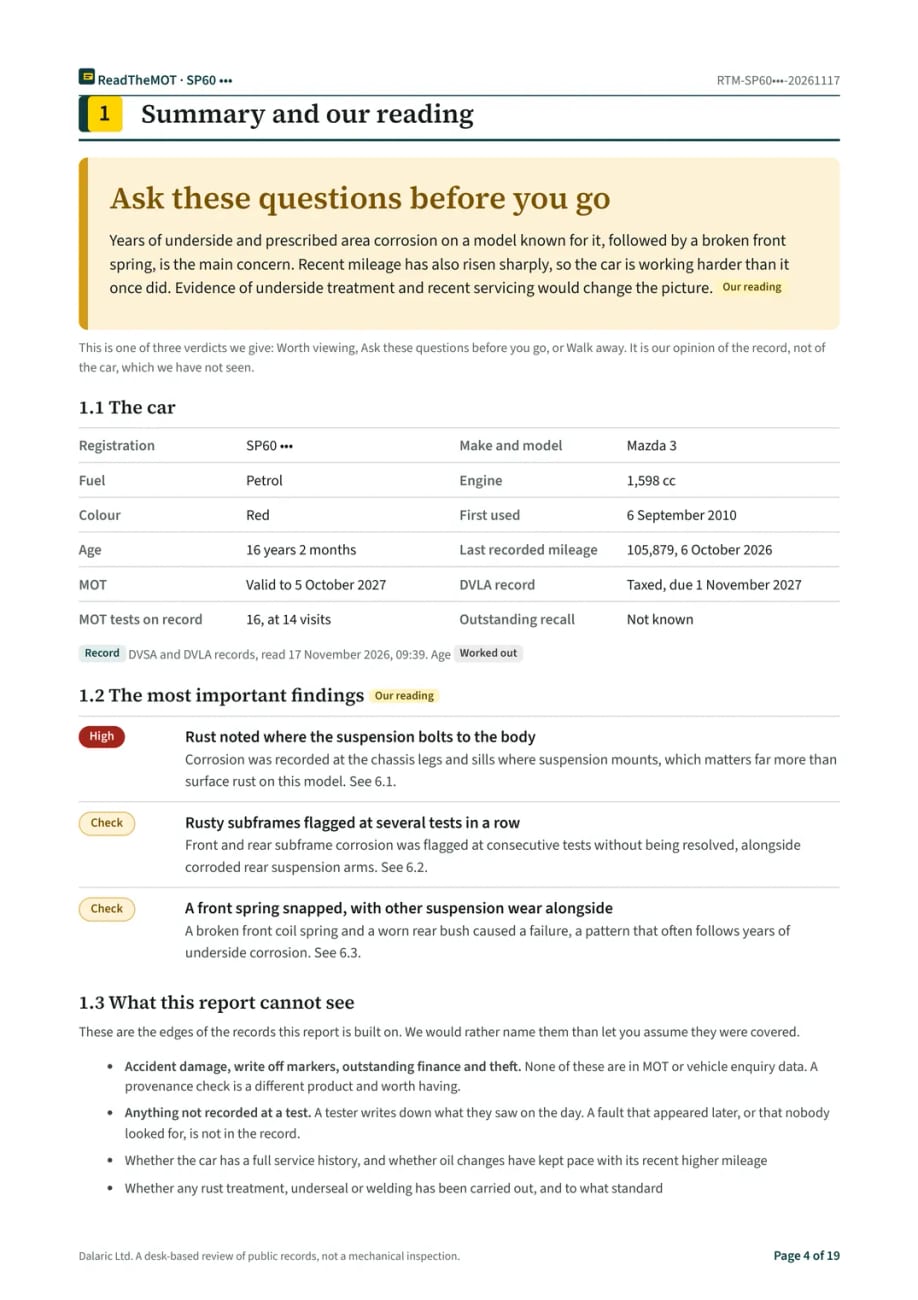
One registration in, one written report out. It takes the full MOT test history from the DVSA and the vehicle record from the DVLA, adds keeper, logbook and factory details bought from a vehicle data company, and reads the whole record as a pattern rather than a list.
How it is built
Four steps, and only one of them is allowed to be creative.
- The record comes in from the three sources: every test, every advisory and defect with its code, every odometer reading, the tax status and the keeper history.
- Code computes the facts. Mileage and the gaps in it, intervals in days, advisories that repeat, failures followed by a quick pass, the tax band. None of it goes near a model.
- A language model reads it, with the computed facts, the raw record and a knowledge base of what these patterns mean in practice, and writes the findings and the questions to ask the seller.
- Every quote is checked back. Each line the model presents as a quotation is looked for in the source record, for the test date it cites. A quote that does not match is dropped and logged, and a report that loses too much is held for a person to read rather than sent.
Why the order matters
Language models are poor at arithmetic and they invent quotations. So everything that can be arithmetic is done in code first, and the one creative step is fenced in by a check that is a gate, not a review. Every report also says which of its parts are from the records, which are worked out, and which are a reading, so the buyer knows which sentences they are allowed to argue with.
How it is tested
Ten real cars' records are kept as a fixed test set, chosen for what they show: corrosion that gets worse over four years, a three year testing gap, a written off car, and three clean records for comparison. A change to the model's instructions is scored against that set before and after, so a change that reads better on one car but worse on the rest shows up before a customer sees it.
Each report carries a check code, so anybody the buyer shows it to can confirm at readthemot.uk that it is the report that was made.
What it runs on
- A Laravel application on Dalaric's own server in London, which accepts web traffic only through Cloudflare
- The public website at readthemot.uk, served by Cloudflare
- The same customer portal as Dalaric's other products, for the account, the payment and the reports
- The DVSA and DVLA published data, under the Open Government Licence
The numbers
- 3
- Data sources read as one record
- 10
- Real cars in the test set
- 8 of 12
- Cars with a problem the advert left out
How long it's been running
Since 23 November 2026, which is not long. The rest of the work page is what I would point to on how long the things I build keep running.